STV elections
STV voting: elect a board with
a single transferable vote
Single transferable vote (STV) is a way to fill several seats in one election. Voters rank the candidates, and votes a candidate does not need pass to each voter’s next choice, so the people elected reflect the range of views among the voters.
Free trial · No credit card required · Nonprofit pricing available
What does STV mean?
STV stands for single transferable vote. It is a voting system for elections with more than one seat to fill, such as five board seats and a pool of twelve candidates. “Single” means each voter has one vote. “Transferable” means that vote can move to the voter’s next choice.
You may know it as proportional representation by STV, or as multi-winner ranked choice voting. It is used for public elections in Ireland, Scotland and Australia, and by co-operatives, unions, associations and clubs to elect boards and committees.
How an STV count works
Each voter ranks the candidates in order of preference. The vote counts for their first choice. If that candidate has more votes than they need, or has no chance of winning, the vote moves to the voter’s next choice instead of being wasted.
- Set the quota. This is the number of votes a candidate needs to win a seat. The usual one is the Droop quota: the votes divided by one more than the number of seats, rounded down, plus one. With 100 votes and four seats, the quota is 21.
- Count first preferences. Any candidate who reaches the quota is elected.
- Transfer the surplus. Votes an elected candidate holds above the quota pass to those voters’ next preferences, at a fraction of their value.
- Eliminate the lowest. If nobody has a surplus left to transfer, the candidate with the fewest votes drops out, and their votes pass to their voters’ next preferences at full value.
- Repeat until every seat is filled.
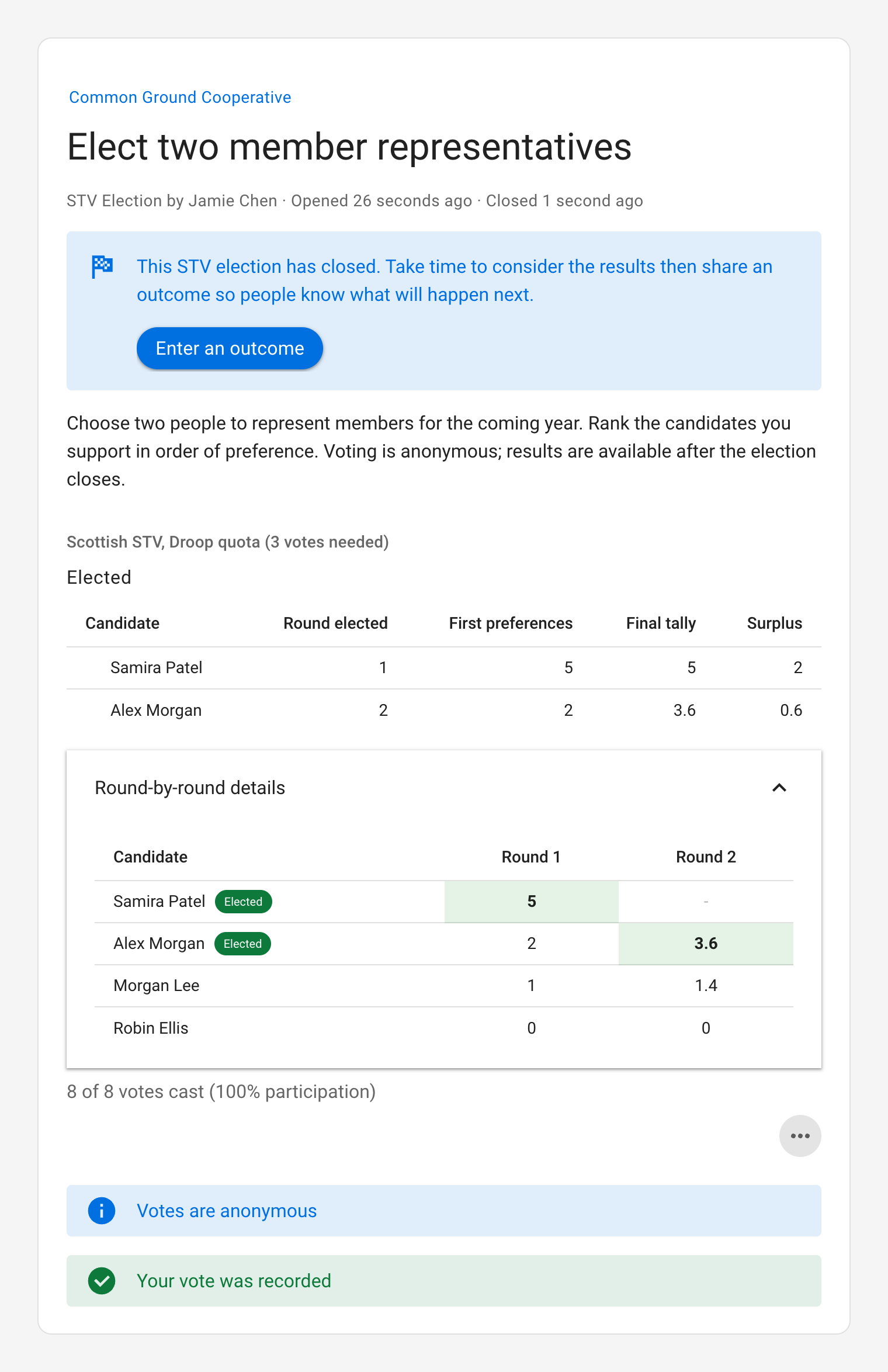
A small example: eight people vote to fill two seats, so the quota is three. Samira gets five first preferences and is elected with a surplus of two. Each of her five ballots passes to its next choice worth two-fifths of a vote. Four of them rank Alex next, which takes Alex from 2 votes to 3.6, over the quota, and Alex wins the second seat.
Voters do not have to rank everyone. A ballot stops counting only when every candidate it ranks has been elected or eliminated.
When to use STV
STV suits elections where several people are chosen at once and you want the result to represent more than the largest group of voters.
Boards, committees and delegates
Use it to elect a board, a committee or a slate of delegates from a pool of nominees. Giving every voter one tick per seat can let the largest group take every seat. With STV, a group of voters with enough support to fill a quota wins a seat, so minorities are represented in proportion to their numbers.
When your rules call for it
Some constitutions name STV, preferential voting or proportional representation for elections. Check which counting rules and quota yours specify before you set up the ballot.
When something simpler will do
A motion needs a yes or no vote, not a ranking. An election with no more candidates than seats has nothing to count; ask members to confirm the nominees instead.
How to run an STV election in Loomio
An STV election is one of Loomio’s poll types. Candidates can introduce themselves and answer members’ questions in a discussion, and members vote in the same place.
Step 1
Add the candidates
Start a poll, choose STV Election, and add each candidate as an option. Describe the role and the term in the details.
Step 2
Set seats and counting rules
Enter the number of seats, which must be fewer than the number of candidates. Choose Scottish STV or Meek STV, and a Droop or Hare quota.
Step 3
Choose the voters and the dates
Let the whole group vote or select the people who are eligible. Set when voting opens and closes, and turn on anonymous voting if you need a secret ballot.
Step 4
Publish the result
When voting closes, Loomio runs the count. Share an outcome that names the people elected and says when their term starts.
Voters drag candidates into order.
Each voter drags the candidates they support above a line and puts them in order, with their first choice at the top. They must rank at least one candidate and can leave the rest unranked.
With anonymous voting on, Loomio stores the record of who voted separately from the ballots, and results stay hidden from everyone until the election closes. A voter cannot review or change an anonymous ballot after submitting it.
How anonymous voting works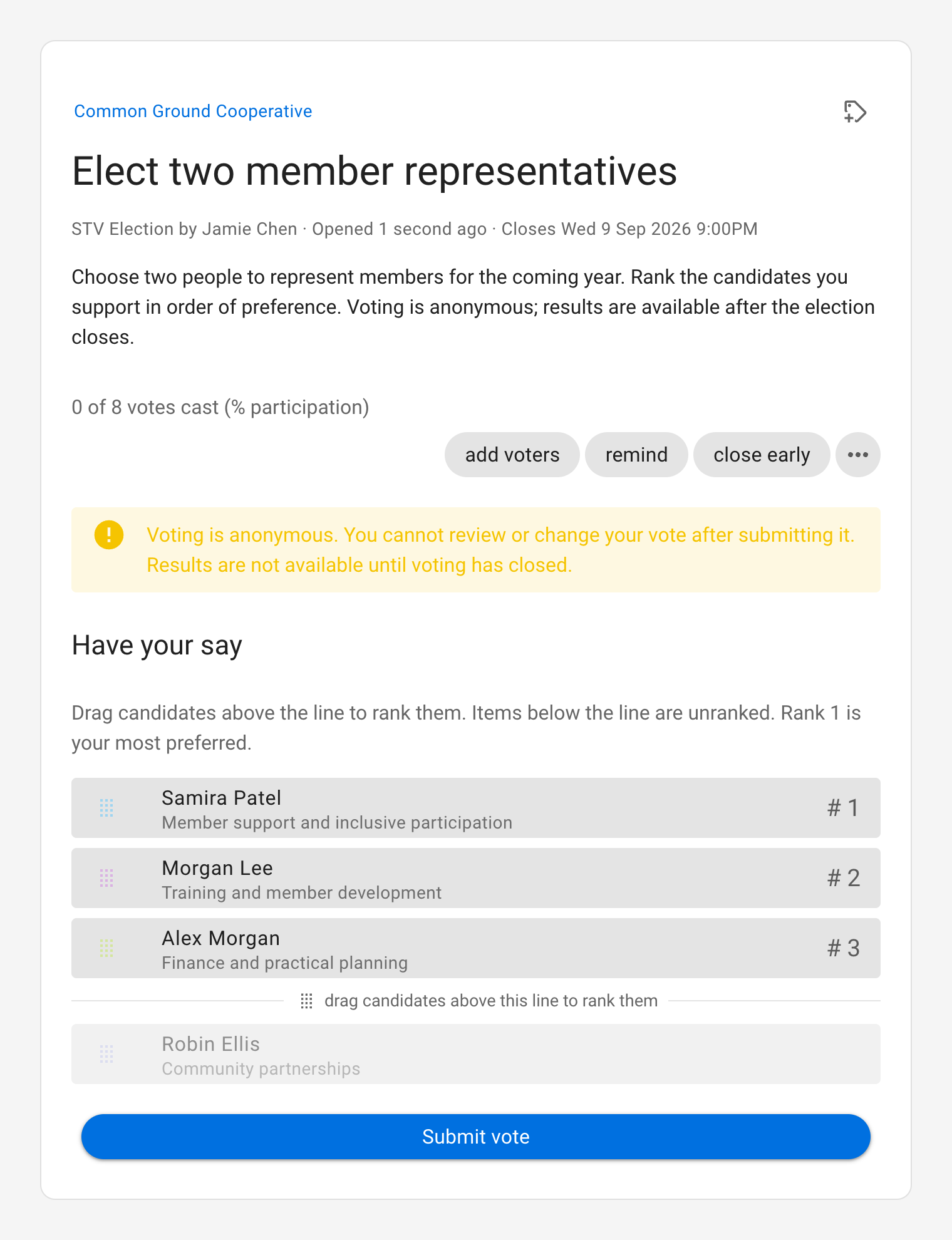
A count anyone can follow.
Results show the counting method, the quota, and a table of who was elected: the round they won in, their first preferences, their final tally and their surplus. Open the round-by-round details to see every transfer and elimination.
If a tie would change who is elected, Loomio shows the candidates as tied. It does not pick one at random.
After the election closes, people who can see the results can export the ballots in BLT format, a plain-text file other STV counting programs can read, for an independent recount. For an anonymous election the export has no voter identities, ballot identifiers or submission times.
STV elections in practice
NYC Democratic Socialists of America, a volunteer-run chapter of 15,000 members, runs STV elections in Loomio. Read the NYC DSA story to see how the chapter makes decisions at that scale.
Who gets a vote matters as much as the count
OpenSSL’s communities elect advisory committees in Loomio. In one of them, a single large company had enough staff to decide the result on its own.
“We had, particularly in the Large Businesses community, a very contentious election where we had six people vying for one seat. It was obvious that a large company could outvote any other candidate to move their candidate.”Anton Arapov, Operations Director, OpenSSL
OpenSSL now names one delegate per organisation and runs these votes for delegates only, so each company has one vote. Read the OpenSSL story, or see how delegated voters work.
Common questions about STV
Is STV the same as ranked choice voting?
STV is ranked choice voting for several seats. Ranked choice with a single winner is often called instant-runoff voting. Loomio also has a separate Rank poll, which adds up points for each ranking to put options in order. It is not a proportional election method, so use an STV election to elect several people.
Scottish STV or Meek STV?
Loomio recommends Scottish STV for most organisations. It is the method used in Scottish local elections since 2007, and its rules are well defined and straightforward. Meek STV wastes fewer votes, but only a computer can count it, so the result cannot be checked by hand. If your rules name a method, use that one.
Droop or Hare quota?
Droop is the standard STV quota, used in Ireland, Australia and Scotland, and the one Loomio recommends. Hare is larger: with 100 votes and four seats, Droop is 21 and Hare is 25. A larger quota makes smaller groups more likely to win the last seats.
Can the election be a secret ballot?
Yes. Turn on anonymous voting before the election starts; it cannot be switched on or off afterwards. Results are hidden until the close, and an anonymous election cannot be reopened once it has closed.
Can we require a minimum turnout?
Yes. Set a quorum as a percentage of eligible voters, and the results show whether it was reached. Votes in an STV election cannot be weighted: each voter has one vote.
Will Loomio run our election for us?
Loomio is the software: you set up the election and Loomio counts it. It does not act as an independent returning officer or certify the result. If your rules require a returning officer, that person can check the count from the round-by-round results and the ballot export.
How do we know the count is right?
Run a test election first and read the rounds together. For the real one, export the ballots and count them again in another STV program, or by hand if you chose Scottish STV. Members worried about who can see or influence the result can read how anonymous voting protects ballots, and its limits.
How do I vote against a candidate?
Leave them unranked. A candidate you do not rank gets no support from your ballot at any stage of the count. Ranking someone last is still a preference for them over the candidates you left out.
Related guides
Online voting
Motions and elections for member organisations, for one annual price.
Loomio for boards
Deliberate, vote and keep the record between meetings, including board decisions between meetings.
Run a practice election first
Set up a small STV election with your committee, on something that does not matter, and read the count together. Then you will know what members will see on the day.
The free trial runs for 14 days with up to 10 people · See pricing